The finding
Two-thirds of old collective heating installations are poorly balanced. This unfortunate situation largely contributes to the thermal discomfort experienced by occupants. Flats closest to the heat source (boiler, heat pump etc.) are often overheated, while those furthest away struggle to get enough heating.
Furthermore, successive energy crises have significantly raised awareness among professionals from all backgrounds, producers and consumers alike, by revealing the close link between comfort and energy consumption.
This raises questions:
For heating networks, how can we ensure energy distribution proportionate to the respective needs of each dwelling?
For domestic hot water networks, how can we ensure good distribution of flow rates at the correct temperature in order to avoid pathogenic problems?
A solution: network balancing
Energy is distributed throughout a system via a heat-transfer fluid, which is generally hot water (or cold for air conditioning).
The role of balancing: to ensure a uniform distribution of temperatures between different rooms.
How: by carrying out precise adjustments and measurements using special valves installed on the networks, so that the quantity of heat-transfer fluid is fairly distributed to the different apartments.
This applies to both older buildings (rebalancing) and new buildings, including low-energy buildings, in which case the adjustments must be all the more precise as the label’s requirements are strict in terms of energy consumption.
It is clear that the hydraulic balancing of heating, air conditioning, and domestic hot water distribution systems is a major challenge for the coming decades.
A quality system is one that is well-dimensioned, well-constructed, and well-balanced.
If even one «link» fails, occupant comfort is reduced, consumption increases, and the user's wallet becomes «lighter»!
The benefits of a correctly balanced installation
Heating savings: in buildings with a central heating system, heating accounts for a large proportion of service charges. In most cases, it is the largest single item of expenditure. This is particularly evident in buildings dating from the 1960s to the 1980s, which are often fitted with boilers that are far too powerful for their actual needs.
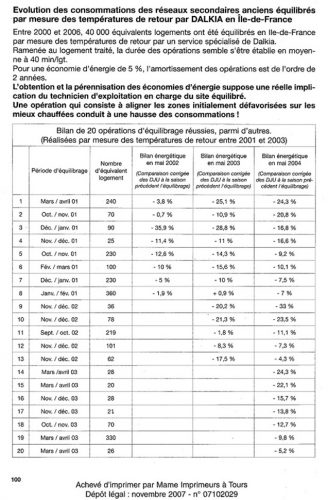
It is generally accepted that balancing the system guarantees savings of around 10%. Balancing therefore contributes to the rational use of energy.
Improved comfort: Avoiding thermal imbalances (areas of under- and overheating) between rooms.
Improved acoustic comfort: better-regulated flow rates, and therefore lower water velocities to minimise noise pollution.
Longer service life of the systems: correctly adjusting flow rates prevents excessive flow velocities, which cause pipe erosion.
A positive step for the environment: by delivering energy savings, balancing the systems helps to reduce the user’s environmental footprint.
The means
The old methods involved adjusting the circulation flow rate on each radiator to achieve good temperature uniformity across the heating coils.
The new balancing principle involves directly setting the temperature of each coil during the heating season, rather than their flow rates, which was merely an indirect and often uncertain means of achieving the desired result.
EQUILOG – Hydraulic balancing software
Mapsec is implementing the new Equilog method for balancing, which optimises and is patented by Gefen/Maximilien Perret and Mapsec.
The main advantages of the Equilog method are:
To allow, without uncertain thermal or hydraulic surveys, balancing perfectly suited to the heating circuit concerned.
To take into account the significant line losses (temperature drop of water during distribution) on old heating water distribution systems.
To implement directly during the heating season, which allows the result to be verified immediately.
To allow the treatment of all types of balancing valves, regardless of their technology.
Mapsec is also the only company capable of assessing the hydraulic situation of your heating network during an audit and estimating the energy savings expected from its rebalancing (R Equilog).